Woofly · Live interpreter
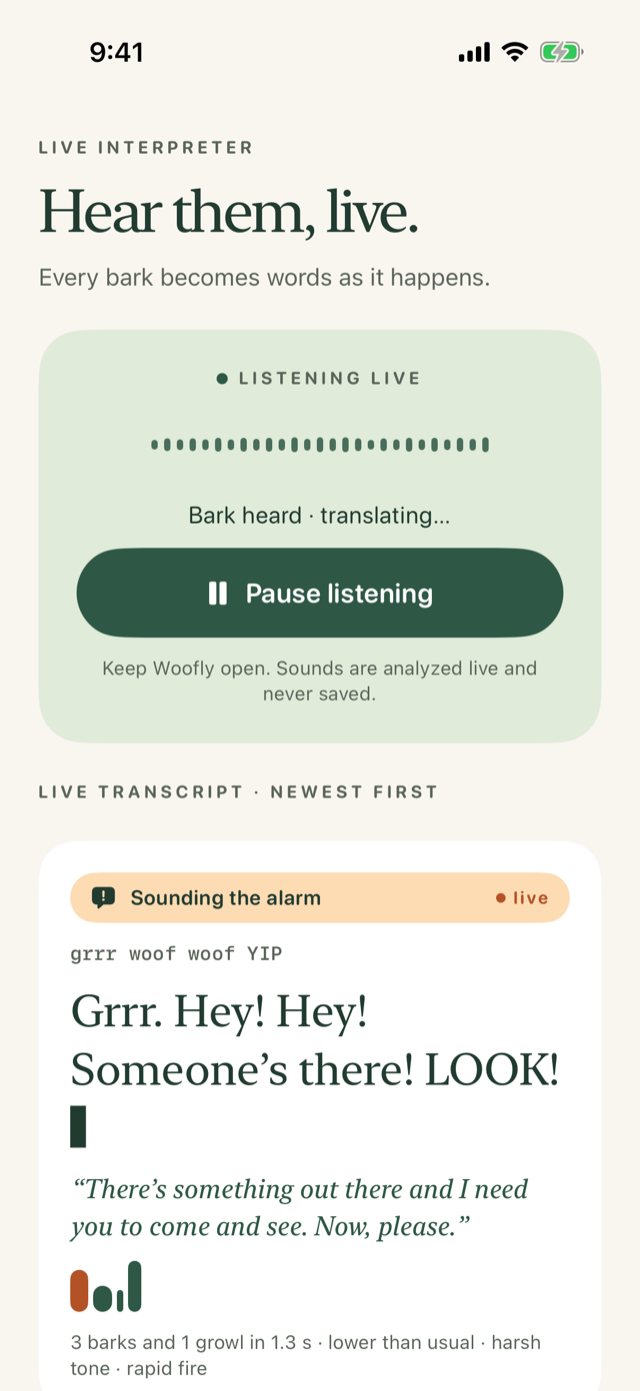
Woofly listens to your dog and turns each bark, growl, and whine into words as it happens. When the outburst pauses, it reads the whole pattern as one of eleven meanings and writes a sentence in your dog’s voice.
iPhone · iPad · iOS 18 or later · Works offline
Live transcript · newest first
yip YIP yip
Hi! HI! Hi hi hi! ▍
“You’re back! You’re BACK! I waited the whole time, and here you are.”
3 barks in 1.1 s · high pitch · clear tone · rapid fire
woof WOOF woof woof arf
Someone’s there! LOOK! Hey hey! Out there! I hear it!
“There’s something out there and I need you to come and see. Now, please.”
5 barks in 3.8 s · mid pitch · harsh tone · steady rhythm
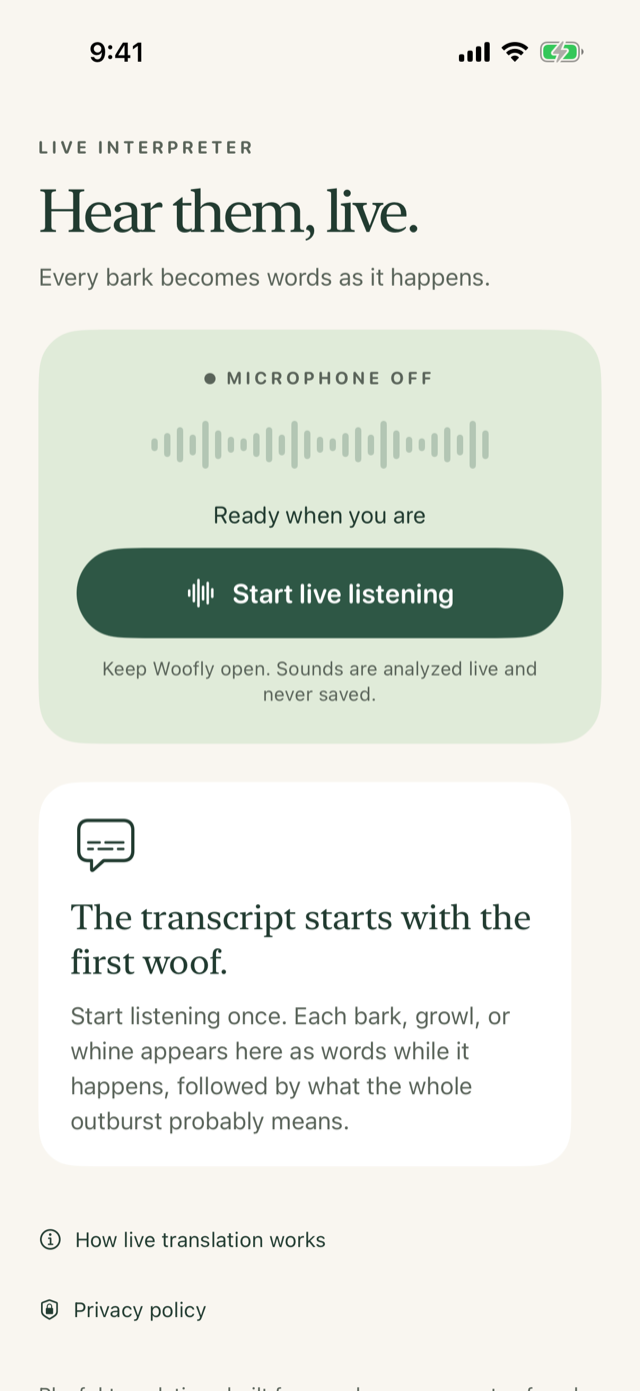
Tap once, keep Woofly open, and read along.
Three stages run on your device, timed by the audio itself.
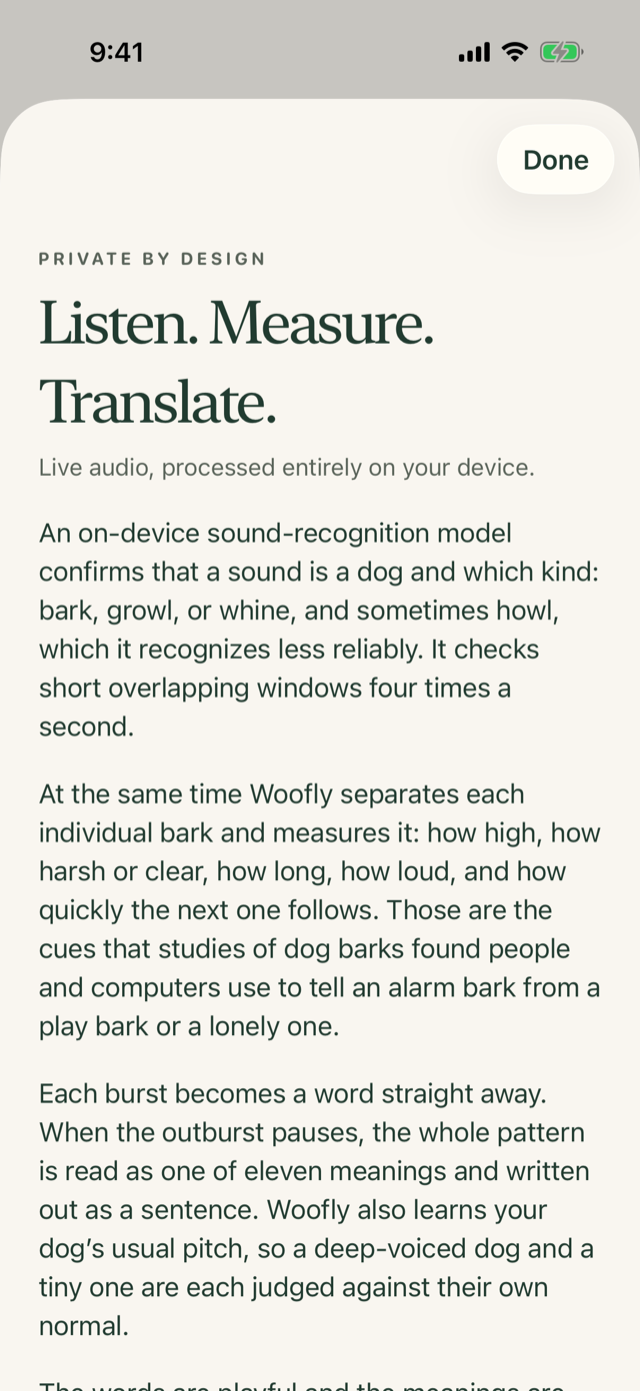
An on-device sound-recognition model checks short overlapping windows four times a second and confirms that a sound is a dog, and which kind: bark, growl, or whine, and sometimes howl. Speech and music are ignored on purpose.
At the same time Woofly separates each individual bark and measures it: how high, how harsh or clear, how long, how loud, and how quickly the next one follows. Those are the cues bark studies found people use to tell an alarm bark from a play bark.
Each burst becomes a word straight away. When the outburst pauses, the whole pattern is read as one of eleven meanings and written out as a sentence. Woofly learns your dog’s usual pitch, so a deep-voiced dog and a tiny one are each judged against their own normal.
Every line in the transcript is tagged with one of these, plus the measurements that led there.
Runs of harsh, mid-to-low barks on a steady beat. Something has their attention and they want yours.
“Someone’s there!”Low pitch and a rough, noisy tone, growls included. A growl is the polite version of a warning.
“Too close.”Higher, clearer, short barks in quick, irregular bursts. Play growls are shorter and higher than serious ones.
“Chase me!”Single or paired barks with pauses in between: the ball, the door, your attention.
“Excuse me.”High, clear barks that climb in pitch, often mixed with whining. The leash, the food bowl, the car keys.
“Is it time?”Long, tonal, slow calls and howls. Dogs left alone bark higher, longer, and more slowly than dogs on alert.
“Hellooo?”Long, steady, very tonal whines that signal discomfort or an unmet need.
“Something’s wrong.”A short, brisk series that keeps one pitch and stops on its own. The mail carrier, a cat on the fence.
“Something moved.”Two or three quick, high, clear barks with no whining. Short, because the news is good.
“You’re back!”Evenly spaced, quiet barks that hold the same pitch and the same beat for seconds on end.
“Entertain me.”One sudden, high, loud yelp with nothing before or after it. The one bark nobody mistakes.
“Ow!”Seven meanings follow the acoustic patterns reported in bark research. The other four, alert, greeting, bored, and pain, follow the bark types dog trainers describe. Each comes with a short note on what to do next.
Audio is analyzed in memory on your device and discarded. Nothing is recorded, saved, or uploaded, there is no account, and Woofly makes no network connections of its own. Read the privacy policy.
The words are playful and the meanings are estimates built from real measurements of each bark, following published research on how pitch, harshness, and rhythm relate to the situation a dog is in. They are not mind reading and not a validated model of canine emotion. A growl during tug is not a threat, and audio alone cannot see the toy. Watch the body language too.
If the transcript keeps saying needs comfort or something hurts, that is a reason to check your dog and call your vet, not a diagnosis.